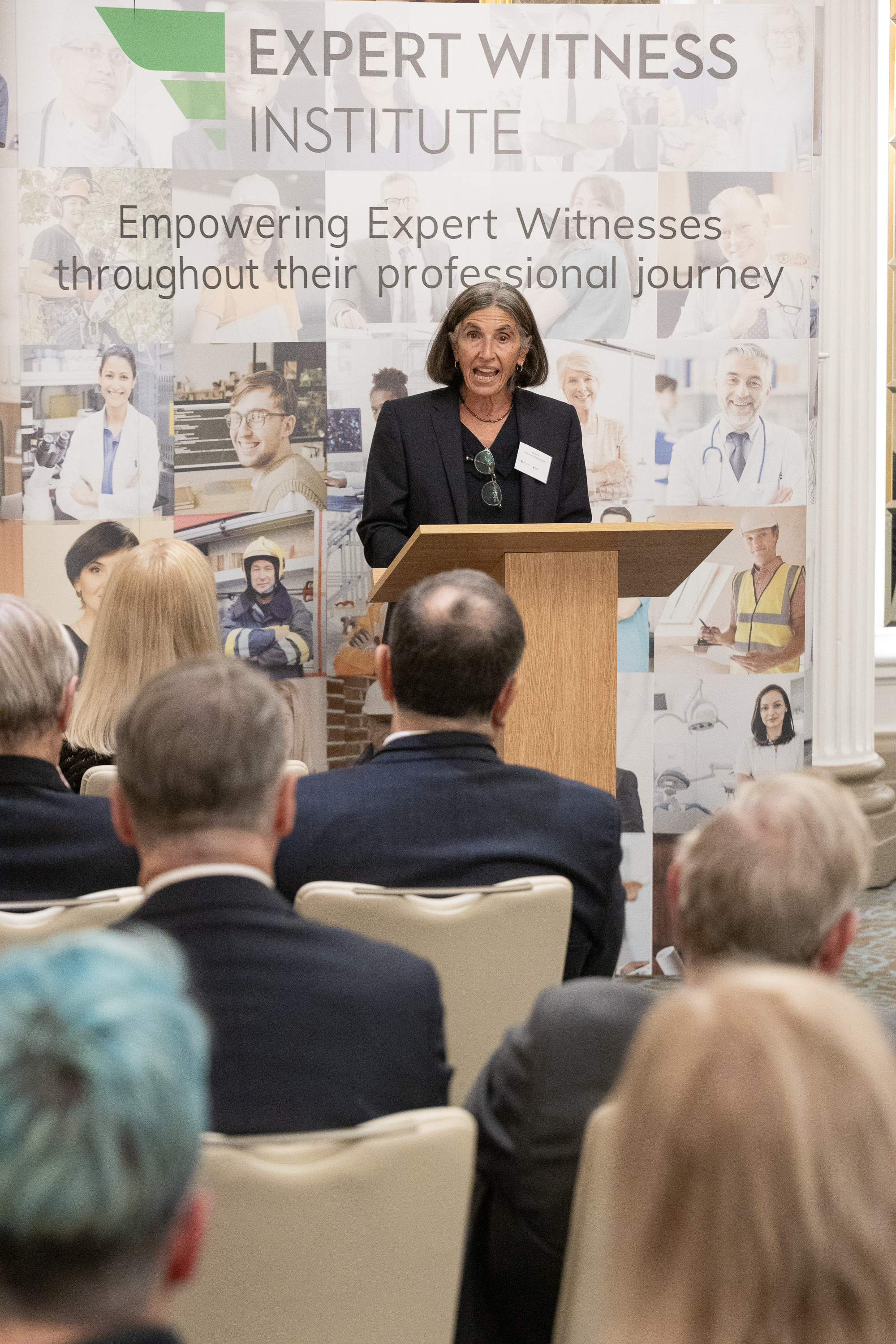
The Annual Sir Michael Davies Lecture for 2025 was held on 15 October at the RAF Club in London. The Right Honourable Lady Simler, Justice of the Supreme Court, delivered an insightful lecture on Enhancing Expert Evidence: Reports, Opinions, and Judicial Perspectives, which was summed up perfectly by EWI Chair Sir Martin Spencer as the blueprint for providing the best written and oral expert evidence.
Intoduction
Lady Simler set the scene for her lecture by noting the importance of the highest quality standards and impartiality of expert witnesses in the context of increasing scientific sophistication, growing public awareness of forensic limitations, and evolving legal standards. Bodies such as the EWI are critical to ensuring Expert Witnesses give the best evidence they can as interpreters of their expert disciplines and act as a bridge between the laboratory and the courtroom.
A fundamental challenge Experts face is serving two masters: satisfying the rigour of their expert discipline while, at the same time, communicating effectively with legal professionals and a lay audience. The Expert must have the ability to think like a scientist while speaking like an educator.
Enhancing written reports
Lady Simler discussed practical ways Expert can enhance their written reports.
-
The structure of a written report is critically important.
-
Reports should be well structured with a logical format that is easy to navigate, including numbered paragraphs, headings and sub-headings.
-
Your summary should answer the fundamental questions.
-
Your methodology section should give an account of the decisions you made and the reasons why.
-
Clarity should be at the forefront of your mind.
-
Use cautious, precise language.
-
Use short sentences and the active rather than the passive voice.
-
Avoid the use of jargon, explain technical terms, and use those terms consistently.
-
Think about how you might use visual information.
-
Confidence in your report is essential.
Enhancing oral evidence
Lady Simler then turned to advice about giving oral evidence.
-
Your goal in oral evidence is to ensure the lay audience understands your conclusions and the reliability of the process that led to them.
-
Preparation and technique can make all the difference.
-
Good preparation should make you ready to explain how you have reached every conclusion you have reached.
-
Ensure that you’ve understood any analysis you’ve relied on, and any key assumptions on which it depends.
-
Try to anticipate areas of challenge and how you might explain your answer.
-
Depending on the case, it might help to create a comprehensive case file including your technical analysis, relevant scientific literature, validation studies and clear explanations of any novel techniques you have used.
-
Be prepared to discuss peer review status of your methods and any ongoing scientific debates that are relevant to your conclusions.
-
Critically, if you need to change your opinion its far better to be upfront rather than remain silent in hope it isn’t spotted by the other side or raised in cross-examination.
-
If possible, attend at least part of the trial before giving your evidence.
Strategies for surviving cross-examination
Cross-examination is designed to test both your technical knowledge and your confidence and reliability, looking to damage or remove some of the internal building blocks that support your opinion.
-
Think through those internal building blocks in your report as part of your preparation.
-
Use the other side’s expert report to test your assumptions and analysis.
-
Nervousness is understandable but can lead to mistakes:
-
Speak slowly and clearly, judge the pace of your delivery by ensuring that the judge’s pen is keeping up with you.
-
Pause before answering questions.
-
Don’t guess – ask for clarification if you don’t fully understand the question and never be afraid to say that you don’t know the answer.
-
Listen to the question you have been asked and answer only that question, not the question you wished you had been asked.
-
Keep your answers short and direct.
-
Don’t be defensive.
-
Your answers to cross-examination should be structured, logical, well-reasoned, while remaining neutral and objective.
-
If asked a binary question, answer yes/no with a but, if you need to qualify your answer.
-
Giving evidence if not a memory test. You are entitled to refer back to your report.
-
Don’t be afraid to say you don’t know.
-
Politely decline if asked to speculate about something beyond your expertise.
-
Recognise that you are not the advocate. Your overriding duty to the court should be the fundamental principle that guides every aspect of your role.
Continuing professional development
Lady Simler concluded by discussing how improving your written and oral evidence also depends on strengthening your role as an independent Expert in whom the legal system can place confidence.
-
Stay up-to-date with developments in your field, maintain active involvement in professional organisations, such as the EWI, attend confernces, etc.
-
Leverage scientific advances while ensuring their appopriate application and keep informed of the scientific and academic debates which surround these new technologies.
-
Develop data management systems to ensure the integrity and accessiblity of that material.
-
Your continuing clinical and practical experience can also be very significant.
-
Actively seek feedback on your written reports and your evidence from the legal professionals with whom you work.
-
Think about joining continuing legal education programmes.
-
Consider opportunities to mentor a more junior Expert Witness.
We highly recommend watching Lady Simler’s full lecture and the Q&A session that follows. The video is available in the EWI webshop at: https://www.ewi.org.uk/Web-Shop#!prod/7347ceef-a6ad-f011-bbd3-7ced8d6ca5a8/curr/GBP
We would like to thank Lady Simler for her insightful lecture, MAPS Medical for sponsoring the lecture, and all the members and non-members who joined us for an insightful and enjoyable evening.